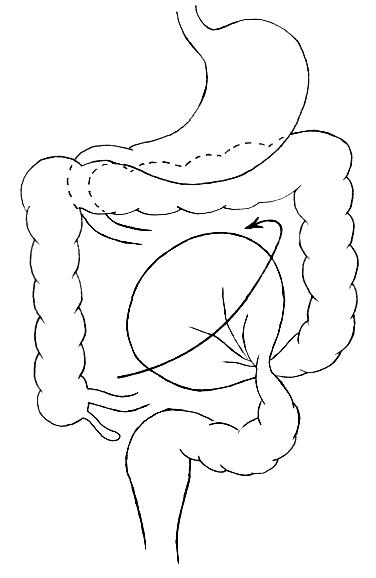
56 year old lady with acute onset of severe abdominal pain and nausea. She had a hysterectomy 20 years ago, no other operations. Overall, a pretty healthy lady. This was one of those calls you get in the middle of the night with a vague preliminary CT read: Small bowel obstruction, cannot rule out a million other things. Her labs were ok so I had them place an NG and admit her. When I examined her early this morning, I was a little concerned. She had focal peritoneal signs in the RLQ and also in the epigastrium. She was also distended with tympany, but the distention interestingly enough, was asymmetric; right sided predominance. The radiologist who reviews the Nighthawk scans from the night before called me and expressed concern about possible cecal volvulus. We went through the scan together and it seemed compelling to me. I re-examined her and recommened at least sticking a scope in. As soon as I established pneumoperitoneum and slipped in the laparoscope, I started telling the team to open up the laparotomy packs. Her cecum was the size of a basketball, flopped over medially and pointing toward the LUQ. Cecal volvulus. I opened her up, detorsed the entire ascending colon and performed a standard right hemicolectomy. There were some patchy areas of ischemia but no frank gangrene.
Colonic volvulus is a cool disease process for a surgeon. It takes a little bit of thinking and work to diagnose and the treatment usually involves some sort of colectomy. It's a mechanical problem and definitve surgery is usually curative. It's pretty satisfying when all goes well.
"Volvulus" means twisting of the bowels, usually around it's mesenteric axis. Obstruction and ischemia are the most feared complications. Most cases of volvulus in the United States affect the sigmoid colon. What happens is you get a redundant loop of sigmoid on a narrow mesentery that can twist on itself. We usually see this in older, debilitated, institutionalized patients. Chronic constipation plays a role. Initially you try to decompress the volvulus with either a flex sigmoidoscope or barium enema. The you can electively do a one stage colectomy after a bowel prep.
Cecal volvulus is a little bit of a misnomer. It isn't just the cecum that volvulizes. The entire ascending colon lacks normal fixation to the retroperitoneum and you get cecocolonic twisting around the ileocolic vascular pedicle. Patients will present with apparent distal small bowel obstruction and decompressed distal transverse colon. Contrary to sigmoid volvulus, non-operative decompressive techniques for cecal volvulus are unsatisfactory. You have to take these patients to the OR. I did a right hemicolectomy because I think that is the safest, most definitve operation. People have described simply performing a cecopexy and placing cecostomy tubes, but I think those options are fraught with complications and carry unacceptably high recurrence rates. Certainly, if the patient is toxic and unstable, with advanced bowel ischemia, you might have to consider a temporary ileostomy with mucous fistula.