Tuesday, November 18, 2008

Max Baucus and Budget Neutrality


So we've all been reading lately about the Baucus plan to re-invent healthcare delivery and to save primary care in America. It's the hot topic on KevinMd right now. Most of it is over my head and, frankly, uninteresting to me. It's 100 pages of wonkish policy drivel, as far as I'm concerned. (For example, here's a paragraph from the section regarding malpractice reform: "Malpractice reform could address money and time spent on litigation, as well as improve patient and provider satisfaction with the resolution of complaints or grievances. Additionally, changes made as part of reforming the health care system would affect medical malpractice. For example, damages awarded for care necessary as a result of malpractice would be reduced because the cost of care would decrease across the board. Also, improvements in preventive care and care coordination would reduce the likelihood of risky procedures that are a source of malpractice claims." Um, whatever the hell that means. As I read the words, the only sense I can make of it is that by lowering the overall cost of health care delivery {via the genius of Max Baucus} then if there is malpractice committed, the costs of paying for care provided to correct said malpractice will be less. Circular and vapid reasoning, at best.).....Just give me a bunch of of patients with peritonitis and I'm happy.

One thing to address, however. The plan clearly spells out an intention for "budget neutral" increases in the remuneration of primary care physicians. That means taking money out of the pockets of specialists and sticking it in the white lab coats of your local family docs. Obviously, primary care isn't paid commensurate to the work they do. Reimbursement is tilted overwhelmingly toward proceduralists. Dermatologists and gastroenterologists are making three and sometimes four times as much as the primary care provider who refers them business. As a result, medical students are fleeing careers in primary care like a bunch of gazelles that spot a lion stalking them in the savannah. Why work long hours with miserable pay when you can work less and earn more and do cool procedures instead of managing the tediousness of chronic diseases? Isn't it human nature to opt for the latter? I guess I don't blame these young kids.

With the Baucus plan, the discrepancy will be corrected by moving money from the overcompensated specialists to our poor, bedraggled primary care docs. Budget neutral. Because, you know, it's not like you could conceive of simply improving reimbursements for primary care independently of how specialists are paid. That won't do. There won't be enough money to pay for the massive federal bureaucracy soon to be created to administer the One's inchoate national health care delivery system.

In football, for the longest time, the guys who got the big contracts were the glamour positions; quarterback, running back, occasionally wide receiver. And then everyone realized that the "skill position" stars were useless you had a decent offensive line. Linemen are extremely unglamorous. You couldn't identify these behemoths if you sat next to them at the Multiplex watching Quantum of Solace. They're anonymous and large and seem to earn paychecks by banging their bodies with utmost violence against other enormous humans lined up across from them. But it became obvious that your pretty boy QB wasn't worth a mound of dirt unless you had a stud left tackle protecting his blind side. That Jim Brown-esque running back of yours was a waste of a signing bonus unless you had the beef up front to open up holes for him. So what happened is, the really good linemen started getting paid. Guys like Steve Hutchinson and Alan Faneca and Bryant McKinnie now have compensation packages not far off from what the top tier of QB's get.

So what the hell am I talking about? Another sports analogy. What else is new from me. What I'm saying is that if primary care docs and internists want to start earning what QB's, I mean specialists, make, then they better be damn good at what they do. I was chatting with one of the ID guys the other day and I noticed his list was almost three pages long. He was pissed off, too. He'd be rounding until past 6pm (this was a saturday). "Most of it's all b.s., he said. This one's a UTI. This one has a decubitus ulcer. That guy has pneumonia. This one, they thought he had a fever in the ER but he really didn't; clerical error." Dr ID pal of mine was busy with a bunch of nonsense. His group had had to hire another doc just to keep up with all the work. They literally are seeing close to 90% of the patients on the medical floors. At another hospital I cover, there are three GI groups to cover a 120 bed facility and they're all busy. This is the world internists have created themselves. A patient comes in through the ER with shortness of breath, admitting internist gives orders over the phone, consults are sent out for cardiology and pulmonology. Patient noted to have a WBC count of 12, ID consult obtained. Patient slightly anemic (hemoglobin 11.9) and a GI consult is obtained with resultant inpatient upper and lower endoscopy. Patient a little bloated after endoscopy, vomits that night; surgery consult requested. It happens constantly. Rare is the patient who comes in under the care of an internist, receives a diagnosis and treatment plan from same internist and ultimately goes home once presenting complaint issues are resolved. In happens in surgery too. I've covered for general surgeons who get medicine and ID consults on young patients who are post op from routine appendectomies. It's outrageous. The admitting physician essentially delegates the decision making and diagnostic work to specialists and then swings by every day to review the chart, work done, and to say hello to the patient. It's like Penn St football right now. Joe Paterno is 117 years old and he can hardly walk six feet without falling. He sits up in the press box during games and lets the assistant coaches pretty much call all the plays and run the game down on the sideline. Many of our younger internists are getting trained within this Joe Paterno paradigm of passive leadership.

One argument is that this simply reflects the highly litigious atmosphere of practicing medicine in America and the shotgun approach to getting consults is simply a way to CYA. Defensive medicine is certainly a source of the high cost of health care delivery in the United States and an honest attempt at malpractice reform will go a long way toward reducing a doctor's initial impulse to get MRI's on everyone with low back pain. But nothing is ever as black and white as we would like to make it. Defensive medicine is understandable. But it's important that we aren't equating lazy medicine with defensive medicine. (That line is going to receive some crack backs, I'm sure. I just hope KevinMD doesn't read this and order my subsequent slaying). If internists and primary care docs shouldered more of the work (with better pay, of course) and didn't consult everyone in the hospital for routine admissions, we would see a reduced demand for specialists and market forces alone would make it unsustainable for graduating residents to flock like lemmings to subspeciality fellowships. Primary care/internal medicine is the offensive line of health care delivery. They ought to be paid accordingly. But they're going to have to bang some bodies and get a little dirty to do so.....

Saturday, November 15, 2008

Fly away surgery


I like this idea. It's certain to catch on. Apparently workers for the Wisconsin company Serigraph can have their copays and coinsurance waived for certain elective operations. All they have to do to qualify is hop on a plane and fly half way around the world to a "fancy tourist hospital" in India for the surgery. Now that sounds awesome. I can't think of a better way to recover from a hernia repair or a knee replacement than to fly coach on Continental for 14 hours.

And what about the part-time workers and the new guys with half benefits? What happens if they need a lap chole? Do they also get the tourist hospital treatment? Or do they have to settle for a voyage across the Atlantic on a wooden raft to Bangladesh for bare bones surgery at some open air tent-hospital in the jungle where they give you a piece of bamboo to bite down on instead of anesthetic?

Now I'm all for globalism but there's a point when too much of anything starts to tip matters into the realm of the absurd. What we see here is yet another bad consequence of the forced coupling of health insurance to employment.

Friday, November 14, 2008

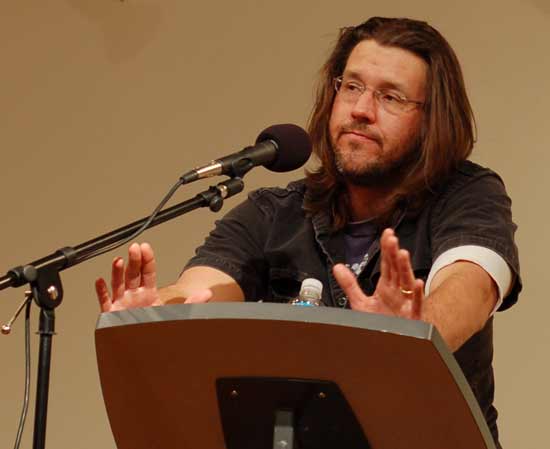
David Foster Wallace and the Old Guy with a Horrible Hairpiece


David Foster Wallace hanged himself on September 12th of this year. He was 46 years old. The news of his death was unexpectedly jarring, a shot to the gut. He was obviously much too young. I was just getting to know him, it seemed. I'd tried reading Broom of the System when I was 23 but couldn't get through it. But I've been reading his non fiction and short stories over the past few years and I realized he was one of those rare authors who speak to something essential yet inarticulated inside me, like Hemingway and Salinger and Chekhov did. He was truly one of our best contemporary writers. Really, he was. For some reason I read his musings on the concept of Infinity while on our honeymoon vacation. What kind of fiction writer/creative writing professor writes full length books about complicated mathematical notions? Currently, I'm plowing through the essays in Consider the Lobster. (My god the piece he wrote for Rolling Stone in 2000 about the John McCain primary campaign (Up, Simba) simply won't get out of my head it's the best thing in New Journalism since that Gay Talese wrote about Frank Sinatra's cold.) Infinite Jest is next. DFW wrote with an energy and originality unmatched by practitioners of modern fiction. And he was cool. He was cool guy. The kind of dude you wish you were friends with or at least a guy who would meet up for beers every once in a while. He wrote about Roger Federer and Tracy Austin and Lobster Festivals and even the National Academy Awards of Porn without fawning or seeming patronizing or smarmy toward the subject matter. He was curious about the world. Things he didn't understand, he simply read and researched them. Because of his youth and edgy style, he brought a cloak of hipness to what was essentially an extremely intellectual and sophisticated mind.

One constant theme running through his work is this entire post-modern angst predicated on self doubt and the tenuousness of a consciousness liberated from historical constraints. It gets away from us, though. We stop being I. We are the voice who watches the I acting in an entirely predictable, banal fashion. And it's supposed to be funny but more than anything else it's frightening as hell...Let me clarify a few things. First of all, this isn't going to be a typical Buckeye Surgeon blog post about dead stomachs or crazy gallbladders or some injustice toward physicians I read about on the NY Times online. This one is going to be long and rambling and it may not be in your taste. Stopping right here may be in your best interest. I'm going to write about things that I don't usually address on this blog. I'm going to open myself up a bit more than I usually would.

Let's start off with this whole concept of Post Modernism. Everyone has heard the phrase. We're in a 'post modernist' era. Deconstructionists and Derrida and Foucault and Lyotard. Those are the names you usually see attached somewhere in a piece about post modernism. It's like if you are writing about "Communism", you're going to see the names Stalin and Lenin and Trotsky scattered throughtout. The difference is that everyone seems to have a solid grasp of what "communism" means: collectivization of resources/wealth, proletariat movement, centralization of power, Gulags, state police, totalitarianism, mass graves, crushing of the human spirit, etc. But post modernism is just a word for most of us. And Foucault and Derrida are just names. We've all come across them at some point and we might be able to answer one of those simplistic Jeopardy questions where the category is "Names that start with F" and the answer is 'this bald guy was a philosopher of the post modernist school' and you can give the question who is Foucault not because of any real knowledge of Foucault or what he wrote about but merely because the Jeopardy game is contrived in such a way that rewards rote trivia retention over true intellect. Anyway. And I don't think it's anything to be ashamed of, not knowing what the hell these guys were talking about. The school of post modernist thought is vague and esoteric and downright unitelligible at times. Here's Noam Chomsky:
There are lots of things I don't understand -- say, the latest debates over whether neutrinos have mass or the way that Fermat's last theorem was (apparently) proven recently. But from 50 years in this game, I have learned two things: (1) I can ask friends who work in these areas to explain it to me at a level that I can understand, and they can do so, without particular difficulty; (2) if I'm interested, I can proceed to learn more so that I will come to understand it. Now Derrida, Lacan, Lyotard, Kristeva, etc. --- even Foucault, whom I knew and liked, and who was somewhat different from the rest --- write things that I also don't understand, but (1) and (2) don't hold: no one who says they do understand can explain it to me and I haven't a clue as to how to proceed to overcome my failures. That leaves one of two possibilities: (a) some new advance in intellectual life has been made, perhaps some sudden genetic mutation, which has created a form of "theory" that is beyond quantum theory, topology, etc., in depth and profundity; or (b) ... I won't spell it out.


Now you're thinking, who does this marginally educated general surgeon in Ohio think he is, proposing to explain post modernism after going to great lengths to portray it as an imprecise, borderline nonsensical fraud, a charade that a legitimate intellectual like Noam Chomsky exposed years ago. And what does post modernism have to do with surgery in general and badly toupeed elderly men specifically? Well I'm not going to explain anything, in the scholarly, professorial sense. I can only simplify a few of the key notions that I have been able to digest. One way to look at post modernism is in contrast to its precursor, Modernism. Modernism is a little more manageable. It's less obscure. You won't find as many sentences like this: (from the scholarly journal Diacritics in 1997) "The move from a structuralist account in which capital is understood to structure social relations in relatively homologous ways to a view of hegemony in which power relations are subject to repetition, convergence, and rearticulation brought the question of temporality into the thinking of structure, and marked a shift from a form of Althusserian theory that takes structural totalities as theoretical objects to one in which the insights into the contingent possibility of structure inaugurate a renewed conception of hegemony as bound up with the contingent sites and strategies of the rearticulation of power." Modernism, for the most part, can be articulated more lucidly. After WWI and the killing fields of the Somme, it dawned on the intellectual elite that maybe universalism and pan-humanistic ideologies and nationalistic fervors weren't such wonderful things. That perhaps it would be better to promote individual perspectives over unyielding previous authorities. It represented a break from the old historical dogmatic shackles, a rejection of previously unquestioned traditions. Institutions such as the church, government, philosophy, and art, were subjected to a reappraisal and were redefined in terms that acknowledged the predominance of the individual. This is probably best represented by the arts of the early Modernist period. Stream of consciousness writing and shifting perspectives, as practitioned by James Joyce in Ulysses and Virginia Woolf in To the Lighthouse, challenged the prevailing literary tradition of having a consistent, chronological narration. The Impressionist school of painting emphasized the ephemeral and the fleeting nature of beauty in the world as opposed to the perpetual exactness of previous art. (Think of the contrast between a series of Monet paintings of the same haystacks but in different seasons versus the austerity and perfect lines and perspective of a Rembrandt portrait.) Basically what we're talking about is the undermining of external authority and preconceived notions of reality by an insurgent individualism. In so doing, two thousand years of foundational standing ground were smashed to bits. Questioning religious dogma was no longer considered "heresy". Protesting authoritarian government did not necessarily make you a rebel or an insurrectionist. According to the precepts of modernism, one has to participate in such fractiousness in order to more fully realize one's individualist potential.

But there's a price to be paid for the destruction of old authoritarian constructs. Suddenly, we're cast adrift, free as can be, but without a net. That can be fun and also not so fun. It can be downright terrifying when someone rips the ground out right from under your feet and all of a sudden you have to tread water or ether or whatever subjective reality it is that we've decided to suspend ourselves in for the rest of our lives. Because that ether is entirely self contingent. You can't take a day off from believing truly in what your mind projects as consciousness. It's all yours, baby. You asked for it and now you have to live with it for the rest of your life no turning back. From TS Eliot's The Hollow Men:
This is the dead land
This is cactus land
Here the stone images
Are raised, here they receive
The supplication of a dead man’s hand
Under the twinkle of a fading star.

Is it like this
In death’s other kingdom
Waking alone
At the hour when we are
Trembling with tenderness
Lips that would kiss
Form prayers to broken stone.


Broken stones are all that's left around us now. Post modernism, then, is modernism turned back on itself. If it's ok to question external forces of authority (church, state, traditional art, etc) then why can't we likewise impugn the veracity and validity of internal sources of authority? Namely, how are we supposed to trust and/or verify that ubiquitous running monologue within our own heads? How do we know it's speaking from a vantage point of objective limpidity? How do we know that what we're feeling or thinking at any one time corresponds even slightly to the actual world or to what 100 other sentient beings would be thinking/feeling under similar circumstances and whether those thoughts/feelings we have are contingent on external forces to varying degrees depending on our education level, our upbringing, our physical environement. Troubling, no? It's like Plato's men in the cave; they didn't realize they were in a cave. The shadows on the walls were a sufficient reality to them because they didn't know any better. So even though shadows on mildewy cave walls are poor substitutes for the lush colors and pungent smells of "reality" as we know it, the truth is, it doesn't matter. Those men aren't coming up out of that cave anytime soon to find out what they've been missing. Post modernism, however, impels one to reconsider one's own self, not just external forces and institutions. It would be like old Socrates yelling down into the cave one night that the cave people were a bunch of idiots because there was a whole different ( i.e. better) reality up with him, only he doesn't tell them how to get there. Not so nice, right? And that's the prick of the post-modernist thorn. We're aware that our own identity/consciousness may very well be arbitrary and foundationless. As a defense mechanism we adopt a mindset of detached irony and amuse ourselves with a knowing cynicism, funnier all the more because we're totally aware that what we're belittling is the same thing that gives rise to our disparaging commentary. Confusing and circular, I know. Makes you want to tear your hair out.

In medicine, we as physicians are privileged to encounter other human beings at their most vulnerable. Illness and pain and suffering break down a lot of the barriers we erect to ensconce us from being exposed. We erect a persona or an ideological front that protects us from the prying gaze of the Other. We can control the projection of an identity. You simply proclaim yourself as doctor, engineer, fireman, vice president of sales. Husband, father. Philanthropist. Criminal. Bad ass. We can spin things so that the message received by most people we encounter is a message we're comfortable with. Image is a powerful force in modern. That's why advertising and public relations are billion dollar industries. But there's no spinning of the truth when you're ill and laced up in an ass hanging out gown, sharing a tiny room on a lousy bed in the hospital. All your cards are pretty much out on the table at that point. There's nothing phony or disingenuous about your situation. And then a well dressed human being in a white coat walks in and starts asking you questions about everything private and embarassing, everything you normally try to avoid thinking about, things your spouse doesn't even know, and then he/she starts examining you, probing you with clinical detachment. A specimen to be evaluated and contemplated.

For doctors, the onus of responsibility in such situations is enormous. Another person is granting you a glimpse of his/her essential being, if only for a few moments. There is an unspoken trust that keeps the whole potentially awkward encounter from going to pieces. Trust that the patient will not lie about his/her symptoms or medical history and trust that that the doctor will act in the patient's best interest. It ought to be as simple as that. But there's more to it. There's more to being a doctor than just an honest exchange of information. Otherwise, it's not such an appealing gig. Although we do occasionally have automaton tendencies, we are also fallible human beings. There's a pay-off that goes unvoiced. We don't like to talk about it but there's something powerfully edifying about being able to assuage a patient's suffering. It's a rush. To help someone. To use a lifetime of study and hard work for the benefit of a stranger. I saw an old lady the other day whom I had operated on several months prior for peritonitis. She was in the hospital for something unrelated and seemed in good spirits. I stopped by just to say hello, recognizing her name on the patient board. She beamed at me when I walked in and grasped my hand. Her daughter was there and they seemed genuinely happy to see me (she'd been lost in the maze of rehab hospitals and long term care facilities). And right as I was leaving the room, the daughter said "Doctor, things moved so fast back then; we never had a chance to say how grateful we all are for what you did." It was heartfelt and real and all I could do was mumble something half way gracious all embarassed as I left. It happens all the time in general surgery. We enter a patient's life at times of great threat and change. With a good outcome, patients are extraordinarily grateful. I always call patients after a breast biopsy to tell them that the pathology is negative for cancer. There's always a half beat silence as it sinks in. And then the warmth suffuses over the phone as they express thanks. You can almost see that death grip on the phone relax as it becomes clear that no, they do not have cancer. Then there was this old lady recently who came in with an incarcerated ventral hernia. I saw her in the ER and made OR arrangements. Before the surgery I met her in the holding area to answer any last questions. I pulled back the drape and had to take a step back. She was surrounded by several large men (all at least 6'3") all talking volubly. She had five grown sons and her husband was hunched over her, holding her hand. Her boys were trying to keep it light, laughing and joking, talking about the Cavs. And then the husband stood and approached me, and he grabbed my hand tight and looked me in the eye hard and forthright and said "I just wanted to thank you so much for taking care of my wife, I love her so much" and his eyes were moist and red splotched and his face was flushed and he was one of those big bears of an old man, white bushy eyebrows and a big paunch and he towered over me with his trembly voice and I noticed his toupee was maybe a little too wooly, didn't quite match the rim of hoary white around his ears and that it wasn't on quite right, tilted forward a bit too much, like he had put it on haphazardly, too quickly, as he rushed to get to the hospital to see his sick wife.

And as the six giant men left, the CRNA whispered to me "you must love that", meaning that it must be such a thrill to be able to be almost a hero for these random strangers who wander into an emergency room. Yeah, I said. It's something. And I really want to believe that it's that simple. It's paramount that what I'm feeling and why I'm feeling it are contingent on human compassion and a simple desire to do a good deed for someone besides myself. Otherwise the the whole system falls apart.

But you wonder sometimes. Post modernist self-doubt compels you. Am I sure that's why I do this work? Am I sure that my motivations are always derived from purely benevolent impulses? I mean, how do I know that the real reason I like being a doctor isn't because I like having people think I'm some kind of amazing hero? Or maybe I just like having people think I'm the kind of person who does good deeds. Or maybe I find compliments self-affirming. Or perhaps I just enjoy the sense of power and control a physician can exert over a vulnerable patient. How do I really know for sure? How do I really know if I'm doing this because I'm such a grand and altruistic guy or if maybe I just like having people be proud of me and impressed by what I do and old guys shaking my hand with reverence and awe. Maybe I just tell myself that I'm acting from humanitarian impulses in order to obscure the true, unacknowledged selfish reasons. And does it matter? Pragmatically speaking, as long as a good deed is performed, the etiology of such action ought not to matter. But I can't let it go. It matters to me. I can't help it.


We've opened this Pandora's Box of ironic detachment and self awareness and life can be analyzed like a plot from an episode of Scooby Doo and it's funny and amusing at first. But eventually, if you follow it through to its logical conclusion, it all just makes your stomach ache your palms sweat your mind spins at night you can't get any rest and it's all, finally, just sort of sad and mournful. Fundamental assumptions like the ineluctability of self identity are suddenly cast into doubt. We begin to doubt whether we can rightly trust our initial emotional responses to situations. Can the uplifting sentiments I'm experiencing rather be explained by something dark and nefarious? We've tossed earnestness to the curb in exchange for unctuousness.

Near the end of Up, Simba, DFW writes about the conflicting feelings he has about John McCain. On the one hand he's impressed by John McCain, the POW and his obvious love of country and the credibility he brings to what would normally be a half-assed campaign exhortation like "to inspire young Americans to devote themselves to causes greater than their own self-interest", but John McCain being a man who repeatedly turned down a chance at early release from a prison camp where he was starved and tortured because "it wouldn't be right, it violated my Code", that John McCain brings a lot of moral weight to a potentially vapid, meaningless slogan. On the other hand, there's all the phony b.s. that a candidate has to subject himself to in order to get into a position where he's a viable contender for the presidential nomination. The same speech he repeats day after day at town hall meetings. The broken promise not to run negative ads. The sleekness and controlled professional verve of an organization that is ostensibly promoting the anti-candidate in such a fashion that makes him look like any other typical candidate for office. It's all so confusing, the conflicting messages. Eventually, the battle between what you want to believe and what your inner, cynical voice is saying you ought to believe becomes more important than what's actually going on in McCain's head. Whether or not McCain is a potentially great leader or just a slick salesman ultimately is irrelevant compared to what's happening in your own heart.

Now I realize David Foster Wallace suffered from depression for over 20 years and I won't presume to know everything that was going on in his head leading up to that fateful day two months ago. But I think DFW woke up every day struggling to overcome this conflict within his heart; whether to trust those warm and fuzzy first impressions, or to succumb to the cynical doubts that crept in with enough introspection. Every day he mounted an effort to ignore that doubting voice that questions our feelings and emotions and casts a pall over anything heretofore thought of as an "authentic" response to a life event. I think DFW exhausted himself mounting that effort day after day. It wore him out. He expended so much energy looking at everything from both sides, trying to be reasonable, giving every point of view it's due (inescapable, from a PM perspective), that he lost his drive to have to constantly redefine and justify himself every morning. He got tired. And then one day in September he hung himself.

I've been thinking about that old guy with the off-kilter toupe and the hearty handshake and the glistening eyes a lot lately. I think about him more than his wife, the actual patient. She did fine but I don't even remember much about the operation. Hernia repair, bowel resection, etc, etc. Presumably, she'll be enjoying another Thanksgiving dinner very soon with her brood of boys. Everything worked out for the best and that ought to be all that matters. But I want there to be more to it than good outcomes and high patient satisfaction scores. There has to be something irrefutably genuine that occurs during encounters between patients and physicians. There will be complications and unfortunate outcomes and mistakes are going to be made and I can handle all that; this surgery business isn't an easy gig sometimes and I knew that going in. I can handle complications. Overcoming external adversity often isn't nearly as daunting as reconciling the internal battles that rage inside our hearts. Somehow we have to quell the rise of this creeping cynicism that threatens to poison everything good and noble we do.....

"There are no choices without personal freedom, Buckeroo. It's not us who are dead inside. These things you find so weak and contemptible in us---these are just the hazards of being free."
-DFW

"Postmodern irony and cynicism's become an end in itself, a measure of hip sophistication and literary savvy. Few artists dare to try to talk about ways of working toward redeeming what's wrong, because they'll look sentimental and naive to all the weary ironists. Irony's gone from liberating to enslaving. There's some great essay somewhere that has a line about irony being the song of the prisoner who's come to love his cage… The postmodern founders' patricidal work was great, but patricide produces orphans, and no amount of revelry can make up for the fact that writers my age have been literary orphans throughout our formative years."
-DFW


R.I.P. Mr. Wallace

Sunday, November 9, 2008

How dare they!

I found this to be highly amusing. Public defenders in several states are suing to limit the number of cases they take on because of ethical concerns that quality of legal representation rendered is compromised by the current overwhelming workload. Can you believe it? How dare they. Here we have a highly educated professional class that provides a necessary and free service to the community and they expect to be able to deliver said service on their terms? It's just ghastly. Unimaginable. It reminds me of another professional class in a similar situation. I can't recall which one exactly. Not malpractice attorneys; they would never turn down a case with merit. Investment bankers? Plumbers? Country club golf pros? Hmmm. It's on the tip of my tongue. Some profession that provides an essential service to its community but is forced to see three times as many patients, I mean clients, in a day just to make ends meet, thereby spending less time than they would prefer with each individual and therefore relying more on specialists and proceduralists to "figure out" what the client's problem is which drives up the costs accrued....I wonder if the solution is to simply hire more foreign medical, I mean law school, graduates to compensate for the shortages. Surely we wouldn't entertain the unfathomable notion that if public defenders and primary care docs were better remunerated, the quality of work provided by each respective professional class might be better and, in the long run, cheaper.

Thursday, November 6, 2008

Warren Buffett and Angelina Jolie's Cambodian children


Warren Buffett made no secret of his support for President-elect Barack Obama. Renowned as the world's most astute and successful investor for nearly a generation, many found it perplexing that he would advocate for the candidate who proposes higher taxes, more government regulation of business, and freely avers that "spreading the wealth" is good for everyone. To such consternation he replied as follows:
They have this idea that it’s “their money” and they deserve to keep every penny of it. What they don’t factor in is all the public investment that lets us live the way we do. Take me as an example. I happen to have a talent for allocating capital. But my ability to use that talent is completely dependent on the society I was born into. If I’d been born into a tribe of hunters, this talent of mine would be pretty worthless. I can’t run very fast. I’m not particularly strong. I’d probably end up as some wild animal’s dinner. But I was lucky enough to be born into a time and place where society values my talent, and gave me a good education to develop that talent, and set up the laws and the financial system to let me do what I love doing—and make a lot of money doing it. The least I can do is help pay for all that.


Sounds wise and full of scrupulous prudence. Certainly, wealth not ought to be concentrated in the hands of the few as long as there are those who cannot afford the basic human necessities. But there's something rather disingenuous and off-putting hearing it come from the mouth of one of the world's wealthiest men. Under the superficial guise of "philanthropy" and "justice for all" one detects an underlying guilt that manifests itself as a scolding rejoinder addressed to the those who have acquired a surplus of bounty. He attributes his success solely to luck and the society that is constituted by the common men and women of this country. Without luck and without the toil of blue collar America, he never could have attained his financial empire. So he says. If we choose to believe him, it sure as hell does paint Warren Buffett is an appealing light, doesn't it? Isn't it swell of him to think that? Maybe he's not such a cold blooded corporate baron after all...

Whether Barack Obama won or lost wasn't going to affect Warren Buffet's bottom line much either way. When you're worth billions of dollars, if all you have to do to assuage any internal guilt at the disproportionate rewards you've received for a life's work manipulating market forces is to simply vote for the man who will raise your tax bracket from 35% to 40%, well it's a no-brainer. Done and done. Similarly, we see these actors and actresses in Hollywood in the forefront of numerous left wing causes (I'm talking about you Tim Robbins and Sean Penn). Angelina Jolie, shedding a bad girl image of numerous failed relationships and french kissing her brother at an awards ceremony, is now a respected humanitarian who donates time and money and her name to various worthy causes. Warren Buffett himself has pledged to give most of his fortune over to the Bill Gates foundation when he dies. I suspect that there is an emptiness and remorse that comes as a consequence of acquiring enormous personal wealth. Earning 15 million buckarooos to play Lara Croft in a Tomb Raider sequel surely can't be the most edifying of endeavours. Nor can watching your portfolio skyrocket to obscene values just because an old college buddy gave you a tip to buy stock in a company called Google fifteen years ago.

The sort of philanthropy demonstrated by Mr. Buffett and Ms. Jolie, however, is not to be mocked. That's not my point. Too many of their brethren don't do nearly enough, given their privileges. The incongruence with the above Buffet quote is that it tries to equate "wealth" as defined by the Warren Buffetts and Peyton Mannings and George Clooneys of the world with "wealth" as defined by most physicians, lawyers, insurance salesmen, and vice presidents of our local banks. And this discordance has been ignored and instead the quote from Buffett is used as a justification for tax policies that will disproportionately affect those who, through hard work, talent, patience, dutiful observance of societal expectations, and yes, even a little bit of luck, were able to achieve what used to be known as the American Dream. Clustering everyone who makes more than $200,000/yr as the "rich" and expecting them as a whole to be as generous and philanthropic as Bill Gates and Andrew Carnegie (when said earners are already forking over 40% of their income to federal and/or local tax repositories) is a damn good way to dissuade future generations from ever trying to aspire to such heights themselves. Mediocrity, unfortunately, may be more enticing for our more gifted youth.

George Orwell writes about the elusiveness and fundamental impracticality of a utopian society in a brilliant essay entitled "Can Socialists Be Happy" (from the collection edited by George Packer called All Art is Propaganda). I know, I know, I sound like a Sarah Palin-ite reactionary expounding on how Obama is a 'terrorist' and a 'socialist'. But we are at a crucial point in American history and Obama could very well be the fulcrum upon which this country turns, for better or worse. When times are tough, there is a tendency to turn inward and expect to be rescued by Big Brother. But as Orwell says, "all favourable Utopias seem to be alike in postulating perfection while while being unable to suggest happiness." Happiness exists only in the contrast of suffering, as a relief from pain. When history brings us to the precipice of despair and loss, it's easy enough to look outside ourselves to those who have "triumphed" in the game of life and demand that they share the fruits of their labor. The danger is that in promulgating policies to guarantee "universal happiness", we risk compromising the motivations for Individuals to perform feats that advance humankind.....

Wednesday, October 29, 2008

The Fall of the Invincible One


Not to delve too far into the realm of hyperbole, but I had the case of a career recently. The patient was a 77 year old vasculopath. CABG. Carotid endarterectomy. Fem-pop bypass. Basically every major blood vessel was afflicted with some degree of advanced atherosclerosis. Patient X had been admitted several times over a four week period for early satiety and abdominal pain. A CT angiogram of the mesenteric vasculature revealed a near complete occlusion of the celiac artery and a high grade stenosis of the superior mesenteric artery. It was a textbook case of chronic mesenteric ischemia. The plan per vascular surgery was to bring patient X in at some point for elective angiography and stenting of the SMA.

Well the patient apparently hadn't read the playbook. Showed up one day in the ER with severe, unrelenting abdominal pain and hypotension. For some reason, an ultrasound was ordered in the ER and the patient was admitted with a diagnosis of "cholecystitis". And that's how I got involved. Well I went to see patient X and frankly I was appalled. Patient X was in some serious trouble. Looked like hell. Tachycardic. Confused. Diffuse peritoneal signs on physical exam. This is more than just a gallbladder problem, I told the family.

I stepped out for a moment and reviewed the blood work and the previous investigations that had been done. The lactate was elevated to 6. The WBC count was 27k. Other than the ultrasound, no other imaging had been done in the ER. I scanned through the CT angiogram of the mesenteric vessels from a month ago. And this is when things started to move quickly. I called the vascular surgeon to inform him of patient X's admission and current decompensation. He rushed right over and concurred with my assessment. Within fifteen minutes patient X was on the angio table. This time, the angio showed a near complete occlusion of the SMA as well as the celiac. Somehow, they cannulated the take-off of the SMA and were able to dilate and stent it. Instantly, blood flow was restored to the mesenteric circulation. The previously hazy, indistinct fluoroscopy screen lit up with a florid, interlaced arterial arcade.

But the patient still looked like hell. There was peritonitis on exam. We went directly from the angio suite to the OR. Anesthesia was given and I entered the peritoneal cavity. I immediately encountered bilious contamination. I started at the Ligament of Trietz and ran the small bowel all the way to the cecum. The bowel was pink and peristaltic and completely non-pathologic. The colon likewise appeared grossly normal. At this point, my suspicion was for a perforated duodenal ulcer but close inspection of the pylorus/duodenal area failed to demonstrate an injury. The only thing left was the stomach. The left lobe of the liver was retracted out of the way and the rib cage was gently elevated to better display the subdiaphragmatic area. What I saw was shocking. The entire stomach, and only the stomach, was black and gangrenous, and there was a large ischemic perforation on the greater curvature. I was forced to do a total gastrectomy with a super-tenuous esophagojejeunostomy reconstruction. At midnight. On a sick old patient with a billion medical issues. God, it's great to be a general surgeon.

The stomach is the supposedly invincible organ of the GI tract, like the queen in chess. It's supposed to be impossible to devascularize the stomach because it gets it's blood supply from so many different sources. The left gastric artery comes right off the celiac trunk. The right gastric artery is a branch of the hepatic artery. The gastroepiploic artery is fed by branches from the SMA and the celiac. The short gastric arteries siphon blood from the splenic artery. It's hard to necrose the stomach even if you're feeling especially reckless and/or malicious. When we pull the stomach up through the chest as part of an esophagectomy procedure, three of the four main arterial trunks are tied off but the stomach does just fine.

What happened in this lady was quite interesting. She already had a near occlusive lesion of the celiac trunk. That knocks out flow to the right and left gastric feeders. Previously she was noted to have a stenosis of the SMA as well. Presumably this SMA stenosis then progressed to the critical point whereby blood flow via the celiac/SMA collateral system was insufficient to maintain perfusion of the end organs. In addition to gastric gangrene, her gallbladder was compromised (I guess the ER was right all along!), and her liver enzymes were greatly elevated post-operatively (indicating ischemic insult to the liver parenchyma). Without the pre-op angioplasty/stenting of the SMA, my surgical intervention would have been for naught. Fortunately, Patient X is plugging right along, doing much better than I would have ever thought....

Tuesday, October 28, 2008

The Choice


There's a fascinating book from 2004 called "What's the Matter with Kansas: How Conservatives won the Heart of America" by Thomas Frank that explores the irony of how middle class, blue collar Kansas became a solid red state, consistently voting for conservative policies that are contrary to its own best economic interests. By using such "hot-button" issues like gay marriage and terrorism and abortion, the Republican Party was able to capture the hearts of Americans who didn't stand to benefit economically from fiscal policies aimed to appease the wealthy.

As this momentous election draws to a close, I find myself in the same position, only for opposite reasons. My wife and I are both physicians. Our combined income will put us in that subset of wage earners who will have to pay the piper with an Obama victory. You know, because we're "rich" and have to "spread the wealth". Even though we didn't start to make anything until we were in our thirties and have a mortgage and owe close to $300,000 in school loans and reimbursements are tumbling and the threat of malpractice always looms, we're the "lucky ones". That's the perception. There's not much I can do to change it. So why on earth would I consider voting for the candidate who aims to take more money out of my pocket and spread it around throughout various aspects of an expanded byzantine federal bureaucracy?

By nature, I have conservative leanings. I believe in individual responsibility. I believe that individuals need to be held accountable for their actions. I believe that increased government involvement in our daily lives leads to stagnation, complacency, and mediocrity. There's a reason this country has led the world economically, politically, and morally for the past one hundred years. Free markets and free exchange of ideas leads to an environment conducive to innovation and creativity. Granted, such a system is susceptible to greed and intransigence but for every Ivan Boesky or James Cayne, there are a hundred more like Bill Gates and Steven Jobs and Sergey Brin. Government intrusion in the form of higher taxes and increased regulation may help to "spread the wealth" but at the cost of hindering risk taking and innovation.

That being said, the Republican Party, ostensibly the steward of conservative principles, has lost it's identity. The past 8 years has witnessed a party hijacked by a fringe contingent of righteously indignant social crusaders. Somehow, the party of Abraham Lincoln and Theodore Roosevelt became the party of Rush Limbaugh and Rick Santorum and Karl Rove. Politics trumped policy. Instead of proposing reality based solutions to the nation's ills, they resorted to meaningless, abstract, somewhat menacing (in an Orwellian way) stock phrases like "country first" and "patriotism". Extraneous right wing causes like gay marriage and gun control issues assumed a prominence in Republican discourse above more substantive concerns. Republican support for the Medicare reimbursement reduction this summer further alienated the party from a reliable ally in physicians.

The Bush administration, moreover, has been an unqualified cataclysm. An ill-advised war prosecuted under false pretenses and conducted with an ineptitude of historic proportions. The prodigal expenditure of American moral authority and international influence through arrogant unilateralism and third world torture tactics at Guantanomo. The Katrina disaster and the delayed, inadequate response. And now, the financial crash on Wall Street, with the inevitable trickle down effect to Main St. George W. Bush has clearly demonstrated that he is a man who lacks intellectual vigor and curiosity. Under his watch, the country has gone from being the unquestioned hegemonic leader of a post-cold war world to an isolated pariah, marginalized in the world's eyes by the failures and embarassment of financial ruin and the debacle of Iraq. His claim to fame was national security. But Afghanistan is spiralling out of control and the Taliban lurks, waiting to pounce on the power vacuum developing in nuclear armed Pakistan. Are we really safer than we were 8 years ago?

Now I like John McCain. But I liked him a whole lot more in 2000. He was the independent, moderate Republican back then. The Straight Talk express. But that campaign was sabotaged by unsavory, deceitful insinuations made during the North Carolina primary by the Bush apparatchiks. The McCain of 2008 is now 72 years old. He made a move to the right, assuaging the Christian Coalition of Ralph Reed and Jerry Falwell. His thinking on issues such as the economy and national security seem very regimented and partisan. I don't sense that McCain, for all his personal valor and strength of character, is much of a consensus builder anymore. And the ludicrous selection of Sarah Palin as a running mate has to be one of the more short-sighted and cynical moves by a candidate for the Presidency in the history of American politics. Her bumbling performances over the past 6 weeks raise serious doubts about McCain's decision making and judgement.

Barack Obama leads this race confortably with less than a week left. He's going to be our next president. But he will ascend to that position despite having a resume thinner than pretty much anyone else who's ever run for the high office. He has no experience in an executive capacity. He is the junior senator from Illinois who has passed no legislation of note. Who has proven to be one of the most liberal voters in the Senate. Who slithered his way through the Chicago political machine unscathed, betraying allies along the way and doing absolutely nothing to clean up one of the most corrupt political establishments in the country. Barack Obama the factual man is extremely unimpressive. His record is sparse. Based on the facts, all we can predict is that he will raise our taxes and implement policies to increase government intrusion into our lives. His campaign is built on vague promises and empty appeals. Change, he says. What's going to change? And how?

And this is the essense of the election. Obama the man has become irrelevant. Obama the concept, however, has swept into the hearts and souls of this country and has attained an unstoppable momentum. This country is hungry for something fresh. The anticipation of his anunciation is a palpable thing. There is an energy and lifeforce to his campaign that is solely lacking from McCain's. He is youthful and a first rate intellect. He presents himself as a man who is guided by reason and fairness. His thinking is refreshingly non-dogmatic. His nuanced reply to the Reverend Wright controversey this summer was one of the most impressive things I've read from a politician in my lifetime. There is a curiosity and intellectual humbleness to Obama that we have not seen from a President in a long time. For some reason, I don't see Obama approaching the Presidency with a strict liberal "agenda". For some reason, I can see him paradoxically acting more moderately than everything in his history would suggest. If he wins as resoundingly as is predicted, I'm willing to give him that chance. The question remains though: are these reassuring qualities by themselves predictive of a successful Obama Presidency?

I still haven't made up my mind. A part of me thinks that maybe it would be a good thing for McCain to lose. Perhaps a resounding defeat would send a message to the Republican Party loud and clear that we have truly entered a new era. Out of the shambles of defeat, hopefully the party could regroup and find itself again. Voting for Obama would be an act of insanity for me, financially. But it's kind of like rooting for your favorite team to lose when the season is already lost, because a worse record will net you a better draft pick. The Cleveland Cavaliers pretty much tanked the 2002 season. The following year, they chose a local kid named Lebron James with the first pick in the draft.

Obama will be inaugurated with a clear majority, an unquestioned mandate to govern, and a legislative branch accomodating to his liberal stances. Time will tell. After all, 2012 is only 4 years away....

Friday, October 24, 2008

K-II


Kellen Winslow Jr., the all-pro tight end for the Cleveland Browns, has always been a little hard to take. The son of a Hall of Famer has had a career marked by controversy and playing field achievement. I've never been a huge fan. He was the villain in the 2003 title game between Ohio St. amd Miami. He has that crazed rant (see above) about being a soldier playing the game of football (while hundreds of American servicemen were dying monthly in the killing fields of Fallujah). Still rehabbing a broken leg his rookie year with the Browns, he foolishly blew out his ACL speeding on his motorcycle. Currently, he's embroiled in a contract dispute with Browns management even though he has several years left on the signed deal. He can be insufferable and incredibly self-absorbed. But, as painful as it is for me to say, I think he's getting a raw deal in this latest flap.

Winslow was hospitalized last week for three days at the Cleveland Clinic Foundation (world renowned, most advanced institute of higher medical performance) under mysterious circumstances. Rumors on the internet suggested a horrifying case of, um, orchitis. Winslow himself broke the silence this week, saying he was afflicted with another staph infection, his second in the past two years. Where and how severe were not identified. Winslow claimed that the Browns "encouraged" him to keep the details of his infection private. When his GM didn't call him in the hospital, his feelings were hurt and he angrily opened up and intimated that his workplace environment is possibly unsafe: “There’s obviously a problem and we have to fix it. Just look at the history around here.”

Seven Browns have now been infected with MRSA (methicillin resistant staphylococcus aureas) infections over the past few years. LeCharles Bentley, recovering from bilateral patellar tendon repairs, developed a MRSA infection that required multiple trips to the OR for washouts and there was talk at one time of the possibility of an amputation if the infection didn't clear. Clearly, there is something going on. Winslow expressed his (understandable) concern to the press and the Browns responded by suspending him for a game and fining him $235,000. The case is currently being appealed by Winslow.

Even in the quasi-fascist realm of the NFL where players are routinely fined for endzone celebrations or having the wrong color socks and are governed by the vaguely menacing and Orwellian "personal conduct code", this is going a little too far. Even Roger Goodell can't legislate what comes out of K-II's mouth. Phil Savage, the Brown's GM, then awkwardly tried to invoke HIPAA laws to justify why the Browns wanted Winslow to keep silent. Of course HIPAA laws don't apply when the patient in question willingly decides to discuss the case publicly himself. The maneuver by the Browns was a bullying, mean-spirited tactic meant as retribution against a player who would dare to speak ill of the "organization".

In the bigger picture, we are starting to see an epidemic of MRSA-related infections in NFL players, especially those in the immediate post-operative period. Recently in the news, there have been stories about staph infections following operations on Peyton Manning and Tom Brady. It isn't just the Cleveland Clinic. And I'm not surprised. From my lowly perch as a general surgeon, I see almost exclusively MRSA related soft tissue infections. Even in community acquired boils/abscesses, it's rare to see one that isn't caused by MRSA. I don't even bother writing for Keflex anymore; doxycycline or bactrim is the choice for presumed staph. Years of inappropriate antibiotic use has led us to the brink of this new epidemic. And there's no better milieu for the rapid spread of a contagious organism than the locker room/weight room setting. It will be interesting to see what measures are implemented to reduce future occurences in the NFL. MRSA is here to stay, however. Secrecy and misinformation campaigns are ill advised coping mechanisms for an issue that will only become more prominent in the days ahead, and can only serve to further alienate athletes from the monolithic organizations that employ them....


Update from 10/25: The Browns have announced that the fine/suspension has been rescinded. Apparently, the Winslow camp presented evidence to the Browns in the form of a text message from a Browns PR representative instructing him to "keep quiet" about the MRSA aspects of his hospitalization... Or maybe Phil Savage just read this post and realized his mistake.

Wednesday, October 22, 2008

More never event absurdity

Just when I was starting to calm down about the controversy surrounding "never events", the New York Times unloads a masterpiece of naivete and contempt. Reading this, my eyeballs almost popped out of my skull. One would think that the editorial staff of such a renowned, prestigous newspaper would exhibit a little more intellectual rigor when composing such a denunciatory op-ed piece. I almost thought Diane Suchetka had infiltrated the NY Times hierarchy.

And now, from the other side of the political spectrum, comes a piece from the National Review (arch conservative publication)that uses the concept of never events in such a way to elucidate the danger of government managed health care delivery. (Thanks to Alice at Cut on the Dotted Line)

To review: "never events" are a new designation for "avoidable" complications that arise during hospitalization. Certainly, wrong site surgery ought not to happen. But the list of never events includes such things as urinary tract infections, surgical wound infections, falls, pressure sores, c difficile colitis, delirium, deep venous thromboses and other similar such events that often arise in the setting of critical illness. Interestingly, you will not find a publishable work of science that describes how to reduce the risk of these events to zero. Why? Because it's impossible. If you put a rubber catheter into your bladder, I don't care how sterilely it's done, eventually a certain percentage of them will cause a urinary tract infection. It's a foreign body, for godsakes. And DVT's are not entirely preventable. Everything we know about prophylaxis with Lovenox/heparin/compression hose talks about risk reduction. There are no magic formulas or medicines or healing balms that will completely eliminate the risk of blood clots. It's absurd. The entire concept is absurd.

Basically, this an attempt to cut costs and distribute blame under the guise of "patient safety". And the ironic thing is, it won't cut costs at all. If anything, we're going to see doctors ordering more tests to prove that the patient had a pre-existing condition prior to admission to the hospital. The rise of community acquired MRSA and even c diff infections mandates this.

Furthermore, these viewpoints articulated by two prestigious national publications illustrate a shocking lack of understanding of the terminology with never event proposals. It attempts to lump together true medical errors (wrong site surgery, blood transfusion reactions) with undesired outcomes that occur despite preventative measures. A bad outcome should never be assumed to be a consequence of a "mistake". It's like sending Josh Beckett down to the minor leagues just because he gives up a home run to a good hitter. Take for example decubitus ulcers. All it takes is 30 minutes of unrelieved pressure from a mattress against your buttocks to compromise capillary blood flow to skin and subcutaneous tissues. Now imagine a 500 pound post op gastric bypass patient flat on her back on an air mattress. It takes 6 people to rotate her every two hours. She gets a pressure sore anyway. At what point was her care compromised? Please demonstrate the error. Ought we to have zero gravity chambers available for such scenarios?

The other fallacy has to do with this idea of "physicians making money off their own errors". Give me a break. Let's say I note a wound infection after a colon surgery. I open the incision a bit and drain the pus. I don't charge for it. The patient goes home with wound care instructions and gauze. Or let's say I diagnose a DVT after a low anterior resection. I put the patient on anti-coagulation and maintain the INR at 2-2.5 for 6 months. I don't charge for it. It all falls under the post operative global billing period anyway.

So let's dispense with this idea that physicians are just racking in the dough taking care of typical post op complications. The entire argument is fallacious and disingenuous. And as long as respected publications like the NY Times and the National Review continue to promulgate this nonsense, the sooner the general public will accept it as the conventional wisdom. Very frightening indeed.....

The Dwindles

There's nothing more frustrating than a dwindler. You get the 83 year old lady with free air to the OR expediently (3am). The operation proceeds quickly and smoothly. You promptly get her off pressors and restore renal function with timely and appropriate resuscitation. Post op she gets extubated by day 2. The stoma looks pink and fleshy and starts putting out stool by day 4. You get her up in a chair. She smiles. Her labs all normalize. Things are progressing swimmingly.

But then she won't eat. She refuses to participate in physical therapy. She lays in bed all day. The smile fades. You enter the room and she barely looks at you, a blank gaze, dull-eyed and lifeless. You try to keep her spirits up. You encourage family members to get involved. But every day you see yet another full tray of cold, uneaten food. She starts to cough a little. You have to commence tube feeds via a nasogastric tube to supplement her nutrition. Then one night you get a call from the nurse. "Dr. Buckeye, Mrs. Dwindles is short of breath and her heart rate has jumped to the 130's. She looks like hell." You send her down to the ICU. CT scans are done. Labs are drawn. She looks septic. The white count is elevated. There's an infiltrate in the lower lobe of the lung. She spikes a fever overnight and continues to deteriorate. She's saturating 89% on a non-rebreather mask. The family opts for intubation and that seems to help for while. Antibiotics are started and she begins to semi-stabilize as the pneumonia clears up. But she never really gets over the hump. She just doesn't seem to have the heart for it anymore. Maybe she stabilizes enough to be transferred to an LTAC, maybe not. Either way, she isn't anything like the woman she used to be. Everything good and vibrant and distinctive about her as an individual has already dissipated. She simply dwindled away.

These sorts of patients can be very frustrating. No matter what you do, no matter how textbook the operation, no matter how perfectly you manage the recovery phase, sometimes the patient fails to progress. You bang your head against the wall searching for an underlying reason. But the explanation is quite simple. A patient needs to want to get well. They have to want it with every ounce of their being. It doesn't matter how hard you work or how many tests you order. Once a patient loses the heart for the good fight, the ultimate outcome is inevitable. For a young surgeon, this can be one of the most difficult pills to swallow...